Wednesday, July 15, 2020
Lockdown Diary: Monday 13.7.20
Not much going on in the garden today, with a Speckled Wood butterfly being the best of the action. Also, there was a Banded General soldier fly flying slowly around the pond (which is now hard to look in owing to the extent of the duckweed!). As I have said before, we do very well for this particular type of yellow-and black banded, wasp-like soldier flies, with their long grey larvae being very common in the water of the pond.


Monday, July 13, 2020
Lockdown Diary, Sunday 12.7.20
Ed and I spent the morning at Castor Hanglands NNR, once more, where the stiller, warmer weather was producing butterflies by the glorious hundred. We saw 14 species here, including a single fly-over Purple Emperor and bucket-loads of Silver-washed Fritillaries.
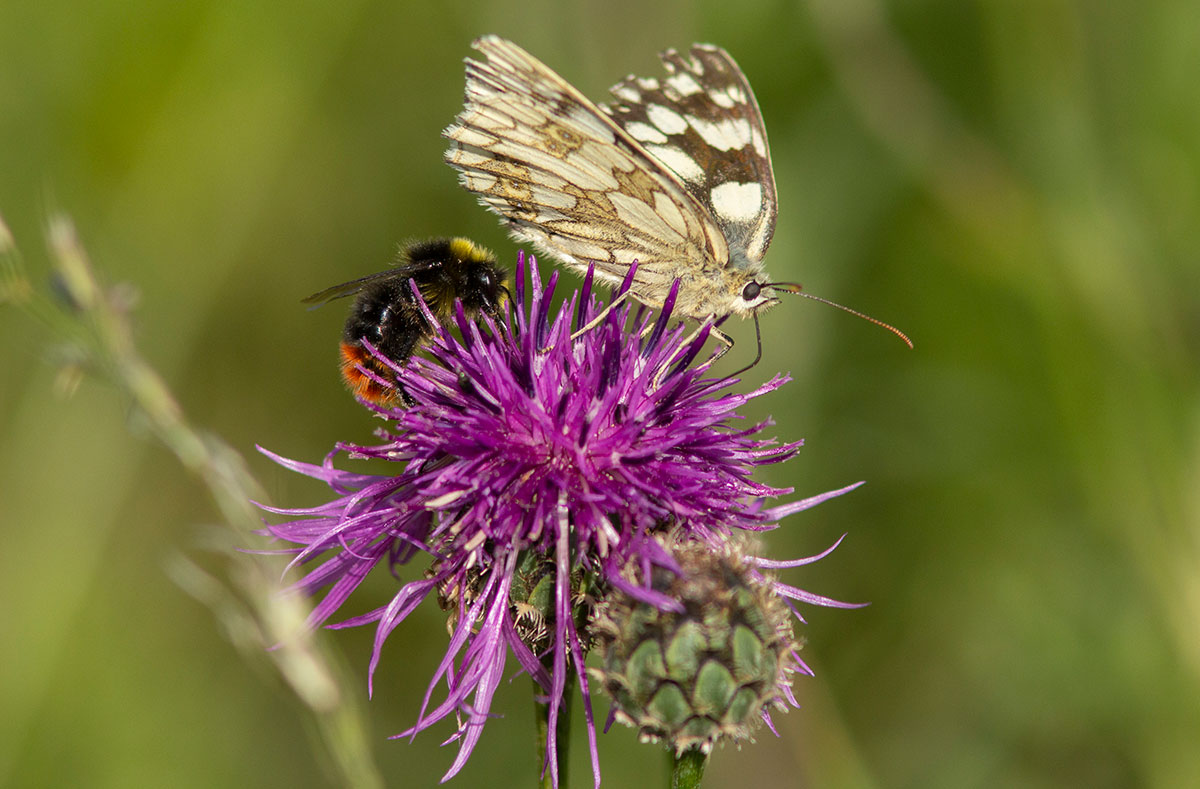
Later, we went to Bedford Purlieus, to enjoy the last of the Dark Green Fritillaries and lots of Marbled Whites, and even later, we went out, together with my dear wife Jo, to Barnack Hills and Holes, which is a renowned wildflower and butterfly site. We greatly enjoyed the Pyramidal Orchids, but only added Small Heath to our day’s butterfly list (there were no blues on the wing), taking the day list to 19 butterfly species.

Dark Green Fritillary, Bedford Purlieus NNR, Cambs, 12.7.20

Marbled White, Bedford Purlieus NNR, Cambs, 12.7.20

Six-spotted Burnet, Barnack Hills and Holes, Cambs, 12.7.20

Marbled White, Barnack Hills and Holes, Cambs, 12.7.20
Later, we went to Bedford Purlieus, to enjoy the last of the Dark Green Fritillaries and lots of Marbled Whites, and even later, we went out, together with my dear wife Jo, to Barnack Hills and Holes, which is a renowned wildflower and butterfly site. We greatly enjoyed the Pyramidal Orchids, but only added Small Heath to our day’s butterfly list (there were no blues on the wing), taking the day list to 19 butterfly species.

Dark Green Fritillary, Bedford Purlieus NNR, Cambs, 12.7.20

Marbled White, Bedford Purlieus NNR, Cambs, 12.7.20

Six-spotted Burnet, Barnack Hills and Holes, Cambs, 12.7.20

Small Skipper, Barnack Hills and Holes, Cambs, 12.7.20
On a tip off, at night, Ed and I were out and about again, this time on the hunt for Glow-worms. There is a site by the Maxey Cut, where we had heard lots had been seen the previous night. As it got dark, so we started noticing the little bright green lights in the grass. By 11.30pm, we had counted 120 Glow-worms!

Glow-worm, near Maxey, Cambs, 12.7.20
Then, I thought, I wonder if you can see that comet NEOWISE in the northern sky. I knew it was somewhere near the Plough, so looked roughly under that constellation, and after a few minutes, I was shocked to see it, with my naked eye. We had binoculars, though, so got wonderful views of the this beautiful comet, with a tail which seems to go on forever! I am not sure what we were more excited about, the comet of the Glow-worms.

Comet NEOWISE from near Maxey, Cambs, 12.7.20
Lockdown Diary: Saturday, 11.7.20
I did a bit of birding in the Deepings area again, this morning, though the wind meant there was not too much new action on my favourite pits (or not any I could see, at least). The best action was at a strange protected pit, we call Molecey’s Mill Pit, where there were 5-7 Little Ringed Plovers, 2 Ringed Plovers, a Common Sandpiper and Grey Wagtail.
So, I went to seek insects at Castor Hanglands NNR, again. There were 11 species of butterfly, including a big increase in Silver-washed Fritillaries (which have expanded hugely around here in recent years), and many Purple Hairstreaks, some of which were coming down almost to eye-level to flash a little purple upper wing…

Female Purple Hairstreak, showing a small patch of purple, Castor Hanglands NNR, Cambs, 11.7.20


Male Silver-washed Fritillary, Castor Hanglands NNR, Cambs, 11.7.20

Female Silver-washed Fritillary, Castor Hanglands NNR, Cambs, 11.7.20

Ringlet, Castor Hanglands NNR, Cambs, 11.7.20
Peacock, Castor Hanglands NNR, Cambs, 11.7.20
So, I went to seek insects at Castor Hanglands NNR, again. There were 11 species of butterfly, including a big increase in Silver-washed Fritillaries (which have expanded hugely around here in recent years), and many Purple Hairstreaks, some of which were coming down almost to eye-level to flash a little purple upper wing…

Female Purple Hairstreak, showing a small patch of purple, Castor Hanglands NNR, Cambs, 11.7.20


Male Silver-washed Fritillary, Castor Hanglands NNR, Cambs, 11.7.20

Female Silver-washed Fritillary, Castor Hanglands NNR, Cambs, 11.7.20

Ringlet, Castor Hanglands NNR, Cambs, 11.7.20

Peacock, Castor Hanglands NNR, Cambs, 11.7.20
Lockdown Diary: Friday 10.7.20
In the evening, I headed out to evening sites of choice, these days, in south Lincolnshire (ie just north of Peterborough, where I live). Deeping Lakes LWT’s east pit had three ’new-in’ Icelandic Black-tailed Godwits (I know they were new-in, as friends of mine had visited earlier and not seen them). Also on the east pit were a nice spangly Green Sandpiper, 2 Little Ringed Plover and an adult Greenshank which called in.

Three Black-tailed Godwits, Deeping Lakes LWT, 10.7.20 At Baston and Langtoft Pits’ ‘Wader Pit’, the Black-necked Grebe was still present. Tre were also three Green Sandpipers in the vicinity, a couple more Little Ringed Plovers, and a couple of Dunlins called as they flew over, heading west.

Black-necked Grebe (and sleeping Pochard), Baston & Langtoft Pits, Lincs, 10.7.20

Three Black-tailed Godwits, Deeping Lakes LWT, 10.7.20 At Baston and Langtoft Pits’ ‘Wader Pit’, the Black-necked Grebe was still present. Tre were also three Green Sandpipers in the vicinity, a couple more Little Ringed Plovers, and a couple of Dunlins called as they flew over, heading west.

Black-necked Grebe (and sleeping Pochard), Baston & Langtoft Pits, Lincs, 10.7.20
Thursday, July 09, 2020
Lockdown Diary: Thursday 9.7.20
Rain kept me in all day, today. Probably the wildlife highlight was while brushing my teeth in the wee room under our stairs. I was terrified by the sudden dropping down of a giant female Daddy-longlegs Spider (Pholcus phalangioides), aka Long-legged Cellar Spider. This ‘room’ is a bit of an arachnophobe’s nightmare, almost a temple dedicated to our spidery friends. I am not sure if the resident house spiders fully embrace the presence of the long-legged recent invaders, as the latter feed on the big chunky bruisers. This ‘dropping’ one though was grabbing and wrapping something tiny in its web, though.

Daddy-longlegs Spider, our downstairs loo, Peterborough, July 2020
I have to admit to being instinctively terrified of sudden appearance or movements of spiders, though my rational brain tells me to admire them!

Daddy-longlegs Spider, our downstairs loo, Peterborough, July 2020
I have to admit to being instinctively terrified of sudden appearance or movements of spiders, though my rational brain tells me to admire them!
Wednesday, July 08, 2020
Lockdown Diary: Wednesday 8.7.20
Here are a couple of photographs for you. The first is a Green Woodpecker that appeared above my head when I was looking at the young kites at Ferry Meadows CP.

Green Woodpecker, Ferry Meadows CP, early July 2020
The second is a type of insect called a soldier-fly. It is known as Stratiomys potamida, or Banded General if you prefer English vernacular names. It is a species which is common in our garden pond, mainly as larvae under the surface. They are long, grey-looking wormy things which are apparently carnivorous, though it is hard to imagine them ever catching anything. This individual was a bit placid, presumably because of the cold weather brought on by the recent rain (or is it the other way round)…

Banded General, our Peterborough garden, 8.7.20

Green Woodpecker, Ferry Meadows CP, early July 2020
The second is a type of insect called a soldier-fly. It is known as Stratiomys potamida, or Banded General if you prefer English vernacular names. It is a species which is common in our garden pond, mainly as larvae under the surface. They are long, grey-looking wormy things which are apparently carnivorous, though it is hard to imagine them ever catching anything. This individual was a bit placid, presumably because of the cold weather brought on by the recent rain (or is it the other way round)…

Banded General, our Peterborough garden, 8.7.20
Tuesday, July 07, 2020
Lockdown Diary: Tuesday 7.7.20
Last night, for the first time in ages, I did a bit of ‘twitching’. Local twitching, of course. I went back up to the Baston and Langtoft pits (BLGP), to see a superb, breeding plumage Black-necked Grebe on the shallow pit we call the ‘wader pit’ there. This particular shallow pit is only half a dozen years old, but has consistently delivered some amazing birds over the years (though it is a tad to flooded fat present or most waders, as such).
The Black-necked Grebe was always distant (too distant for photos), but still a very pleasing sight through the scope. Picture a tiny grebe, not much bigger than a Dabchick, with a jet black triangular head (on a jet black neck), with two inset rubies on fire as eyes, and wisps of gold strands on the cheeks. Very handsome indeed.
Also on that pit were a Little Ringed Plover, a Barnacle Goose (probably the one I never ‘tick’ which has been around there for a decade or more), a single fluffy Black-headed Gull chick (most juvenile BhGs there are flying around by now). A male Marsh Harrier drifted by.
Later, on the way home, I popped into Deeping Lakes LWT, where a new flock of 23 Icelandic Black-tailed Godwits were gathered on the east pit (plus the lone wolf individual godwit, hanging around separately). Also there were one or two Little Ringed Plovers. Just outside the reserve, I saw Little Owl and Barn Owl, to complete a decent evening expedition.
The Black-necked Grebe was always distant (too distant for photos), but still a very pleasing sight through the scope. Picture a tiny grebe, not much bigger than a Dabchick, with a jet black triangular head (on a jet black neck), with two inset rubies on fire as eyes, and wisps of gold strands on the cheeks. Very handsome indeed.
Also on that pit were a Little Ringed Plover, a Barnacle Goose (probably the one I never ‘tick’ which has been around there for a decade or more), a single fluffy Black-headed Gull chick (most juvenile BhGs there are flying around by now). A male Marsh Harrier drifted by.
Later, on the way home, I popped into Deeping Lakes LWT, where a new flock of 23 Icelandic Black-tailed Godwits were gathered on the east pit (plus the lone wolf individual godwit, hanging around separately). Also there were one or two Little Ringed Plovers. Just outside the reserve, I saw Little Owl and Barn Owl, to complete a decent evening expedition.
Monday, July 06, 2020
Lockdown Diary: Monday 6.7.20
It has been a few weeks since I cycled to Ferry Meadows CP and, having lost a bit of weight during the early weeks of lockdown, my heft has once more been creeping up. But, I needed no excuse to head back to FMCP, this morning, though it is ostensibly the quietest time of the year.
My main aim, though, was to check on the Red Kite nest which, you may recall, had two fluffy chicks a few weeks ago. I won’t be saying where this nest is, as it is rather near a very public path, but remains just about unknown to the ‘general public’. I looked up though my binoculars and saw what I took, initially, to be an adult kite, perched a metre or so from the nest. A second look revealed that this wan, in fact on e fo the formerly fluffy juveniles, transformed into a ginger-headed teenager!

Juvenile Red Kite by its nest (and the tail of a second juvenile, if you look under the broad branch at 4 o’clock from the main one), Ferry Meadows CP, Peterborough, Cambs, 6.7.20
I took a few discreet photographs, and noted that the tail of its sibling was also on show, nearby (if the rest of that bird was hidden in Ivy and behind branches!). I am so happy, that the kites here seem to have succeeded in bringing up their two youngsters to very close to independence.

Red Kite feather, Ferry Meadows CP, 6.7.20
My main aim, though, was to check on the Red Kite nest which, you may recall, had two fluffy chicks a few weeks ago. I won’t be saying where this nest is, as it is rather near a very public path, but remains just about unknown to the ‘general public’. I looked up though my binoculars and saw what I took, initially, to be an adult kite, perched a metre or so from the nest. A second look revealed that this wan, in fact on e fo the formerly fluffy juveniles, transformed into a ginger-headed teenager!

Juvenile Red Kite by its nest (and the tail of a second juvenile, if you look under the broad branch at 4 o’clock from the main one), Ferry Meadows CP, Peterborough, Cambs, 6.7.20
I took a few discreet photographs, and noted that the tail of its sibling was also on show, nearby (if the rest of that bird was hidden in Ivy and behind branches!). I am so happy, that the kites here seem to have succeeded in bringing up their two youngsters to very close to independence.

Red Kite feather, Ferry Meadows CP, 6.7.20
Lockdown Diary: Sunday 5.7.20
Another windy day took me to the pits in the Baston and Langtoft area (south Lincs); what we around here call Baston and Langtoft Gravel Pits, or BLGP for short. There is a new pit which had a successful Black-headed Gull breeding season, and I checked it out. All the BhGs have moved on, but the water level looks juicy for waders. Wader-wise here was a single Black-tailed Godwit, and a single Green Sandpiper, plus a pair of Oystercatchers and some Lapwings.
There is a pretty extensive Sand Martin colony in the sandy cliffs, here. Oddy, some of the holes look a tad enlarged, too big for a martin. On one side of this colony, a dozen Stock Doves were clinging to the cliff face, almost looking like South American parrots at a salt lick. One or two flew up and onto the entrance ‘ledges’ large, modified martin holes, almost as if they were using them as nest holes themselves. The seemed to put there heads deeper into the hole, too. Surely, these doves are not trying colonial cliff hole-nesting? Are they feeding on something in the holes, or extracting grit for their gizzards? Perhaps this will remain a mystery.
There is a pretty extensive Sand Martin colony in the sandy cliffs, here. Oddy, some of the holes look a tad enlarged, too big for a martin. On one side of this colony, a dozen Stock Doves were clinging to the cliff face, almost looking like South American parrots at a salt lick. One or two flew up and onto the entrance ‘ledges’ large, modified martin holes, almost as if they were using them as nest holes themselves. The seemed to put there heads deeper into the hole, too. Surely, these doves are not trying colonial cliff hole-nesting? Are they feeding on something in the holes, or extracting grit for their gizzards? Perhaps this will remain a mystery.
Saturday, July 04, 2020
Lockdown Diary: Saturday 4.7.20
It was more than a tad windy (and not a little rainy), today, so butterlfy-watching was just about out of the question, and birding was somewhat limited. I took a trip up to Deeping Lakes LWT, though (much of the viewing is screened, so somewhat protected from the elements.
Highlights were are single Icelandic Black-tailed Godwit, and singles of Little Ringed Plvoer andCommon Sandpiper. A Hobby was flying around catching insects in the same air space as a very decent flock of Swifts (which seemed unperturbed by the falcon’s presence). I counted six Egyptian Geese, in this, their main stronghold in the Peterborough area. Ten years ago, they were very scarce, locally, but at DL, in particular breeding is at least attempted annually.
Talking of breeding attempts, there is only one Common Tern nest still active, the rest having been abandoned or predated, and even the Lesser Black-backed Gulls seem to have given up the breeding season as a bad lot, this year. A couple of days ago, there was asingle Gadwall duckling following its mother. Sadly, even that seems to have gone, now.
On a more cheery note, I saw a singing Corn Bunting further north and east along the banks of the Weland (NE of Crowland), at a place I had not previously seen or heard one.
Highlights were are single Icelandic Black-tailed Godwit, and singles of Little Ringed Plvoer andCommon Sandpiper. A Hobby was flying around catching insects in the same air space as a very decent flock of Swifts (which seemed unperturbed by the falcon’s presence). I counted six Egyptian Geese, in this, their main stronghold in the Peterborough area. Ten years ago, they were very scarce, locally, but at DL, in particular breeding is at least attempted annually.
Talking of breeding attempts, there is only one Common Tern nest still active, the rest having been abandoned or predated, and even the Lesser Black-backed Gulls seem to have given up the breeding season as a bad lot, this year. A couple of days ago, there was asingle Gadwall duckling following its mother. Sadly, even that seems to have gone, now.
On a more cheery note, I saw a singing Corn Bunting further north and east along the banks of the Weland (NE of Crowland), at a place I had not previously seen or heard one.
Friday, July 03, 2020
Lockdown Diary: Friday 3.7.20
All the action came late on, today. I popped out to the car, and as I stepped out of the front doo, I noticed a Hedgehog in our driveway, near the bins! It noticed me and immediately tensed up its spines! Naturally, I went back inside and shouted for my son Ed and my dear wife Jo to come and see the Hedgepig. I went in to grab a camera, and perhaps an empty cardbox to make sure it didn’t wander out onto the road. I left instructions with Jo not to let it wander off, so we could rescue it.
When I got back, the Hedgehog was gone. Jo said she had said ‘hello’ and ‘tried to make friends with it’. It had turned round and walked back through the bins and through the ajar wooden gates of our shambles of a former ‘car port’, which is full of junk and overgrown with buddleias.
So, no photo and we have no idea what happened to this Hedgy…
When I got back, the Hedgehog was gone. Jo said she had said ‘hello’ and ‘tried to make friends with it’. It had turned round and walked back through the bins and through the ajar wooden gates of our shambles of a former ‘car port’, which is full of junk and overgrown with buddleias.
So, no photo and we have no idea what happened to this Hedgy…
Thursday, July 02, 2020
Lockdown Diary: Thursday, 2.7.20
Yesterday, after work, I decided to feed my butterfly addiction, once more, with a visit to Castor Hanglands NNR, which is only a short hop from home. Purple Emperors were once more my aim, and the calm weather looked promising. However, it was a tad too cool for most butterflies, and I only got the briefest glimpse of one PE around a favoured oak I like to stake out. One butterfly which seems to come to life in the last few hours of the day is the Purple Hairstreak, and lots of these wee beauties came out in the cool early evening air, chasing each other around.
Birdwise, I was once more croaked and whistled at by a Nightingale. I took a brief recording of the interesting calls (which I will load to Xeno-canto.org later).
A Hobby whizzed by and as I was leaving I saw this Goldfinch buried among the thistles…

Goldfinch, Castor Hanglands NNR, Cambs, 2.7.20
So, I was once again off to Deeping Lakes LWT. I had heard that 19 Icelandic Black-tailed Godwits had called into the east pit there; and sure enough, they were present and correct when I arrived. There are a couple of viewing screens overlooking this pit, which is covered in islands of various sizes covered in birds!. The Common terns and Lesser Black-backed Gulls have had a disastrous breeding season, though, perhaps owing to visits from the local red Kites, which can snatch a chick with impunity.
Anyhow as I arrived at the slightly more western screen, a bird scarer (they sound like shot guns, and are common round here) went off, and the godwits took flight. I followed a flock of 9 as they circled overhead, then glided back as if to land again. But instead, they headed strongly north, until I could no longer see them. It was 8pm. The other 10 were gone, too.
I scanned the rest of the pit, and located 3 Common Sandpipers, my first of the ‘autumn’! Also there were 9 Egyptian Geese, which is the most I have counted there for a good while, I believe.
At 8.10pm, 9 Icelandic Black-tailed Godwits landed in the exact spot they had been at before. Was this the same 9 as before, or a new 9, I don’t know, but I suspect they may have been the same birds. They drank and fed and settled in quickly. It was interesting to see them occasionally getting feisty with each other and attempting a bit of a bill fight. I don’t think I had ever notice how they dip their tails down and flash the black panel at each other, before.

Icelandic Black-tailed Godwits (the 9), Deeping Lakes LWT, 2.7.20
But at 9.25pm the 9 got agitated and started calling. Were they about to leave? No, they were announcing the arrival of a further 30 Icelandic Black-tailed Godwits to the pit! So, now there were 39 of these brick-red beauties in front of me, chattering away, bathing, feeding and fighting. Icelandic-race birds (Limosa limosa islandica) are smaller, darker red and slightly shorter billed and shorter legged that the nominate European ones (L. l. limosa), which have a tiny foothold UK breeding foothold at the Nene Washes, just east of Peterborough, and so are familiar birds to us Peterborians. The islandica birds also seem to be seem less obviously dimorphic than the limosa subspecies, with males and females looking very similar, equally gorgeous!

Icelandic Black-tailed Godwits (part of a flock of 30), Deeping Lakes LWT, 2.7.20
The ‘original’ 9 edged slowly closer to the newcomers, until they eventually mingled among them and became as one. Then, at 8.43pm, there was more calling than usual and many of the godwits looked upwards. Was there to be a new flock of birds? No, just one, and it was a Ruff, joining the gathered godwits. It also bathed briefly and drank, but 5 mins later, it was off, flying strongly south.

Spot the Ruff. With Icelandic Black-tailed Godwits, Greylag Geese and Lesser Black-backed Gulls, Deeping Lakes LWT, 2.7.20
Are these migrating birds failed breeders or non-breeders, or early breeders heading south? Probably, but none of the perhaps 50-60 Icelandic Black-tailed Godwits I saw this evening were colour-ringed, so this is just speculation. Great birds to watch, though, whatever.
A Hobby whizzed by and as I was leaving I saw this Goldfinch buried among the thistles…

Goldfinch, Castor Hanglands NNR, Cambs, 2.7.20
So, I was once again off to Deeping Lakes LWT. I had heard that 19 Icelandic Black-tailed Godwits had called into the east pit there; and sure enough, they were present and correct when I arrived. There are a couple of viewing screens overlooking this pit, which is covered in islands of various sizes covered in birds!. The Common terns and Lesser Black-backed Gulls have had a disastrous breeding season, though, perhaps owing to visits from the local red Kites, which can snatch a chick with impunity.
Anyhow as I arrived at the slightly more western screen, a bird scarer (they sound like shot guns, and are common round here) went off, and the godwits took flight. I followed a flock of 9 as they circled overhead, then glided back as if to land again. But instead, they headed strongly north, until I could no longer see them. It was 8pm. The other 10 were gone, too.
I scanned the rest of the pit, and located 3 Common Sandpipers, my first of the ‘autumn’! Also there were 9 Egyptian Geese, which is the most I have counted there for a good while, I believe.
At 8.10pm, 9 Icelandic Black-tailed Godwits landed in the exact spot they had been at before. Was this the same 9 as before, or a new 9, I don’t know, but I suspect they may have been the same birds. They drank and fed and settled in quickly. It was interesting to see them occasionally getting feisty with each other and attempting a bit of a bill fight. I don’t think I had ever notice how they dip their tails down and flash the black panel at each other, before.

Icelandic Black-tailed Godwits (the 9), Deeping Lakes LWT, 2.7.20
But at 9.25pm the 9 got agitated and started calling. Were they about to leave? No, they were announcing the arrival of a further 30 Icelandic Black-tailed Godwits to the pit! So, now there were 39 of these brick-red beauties in front of me, chattering away, bathing, feeding and fighting. Icelandic-race birds (Limosa limosa islandica) are smaller, darker red and slightly shorter billed and shorter legged that the nominate European ones (L. l. limosa), which have a tiny foothold UK breeding foothold at the Nene Washes, just east of Peterborough, and so are familiar birds to us Peterborians. The islandica birds also seem to be seem less obviously dimorphic than the limosa subspecies, with males and females looking very similar, equally gorgeous!

Icelandic Black-tailed Godwits (part of a flock of 30), Deeping Lakes LWT, 2.7.20
The ‘original’ 9 edged slowly closer to the newcomers, until they eventually mingled among them and became as one. Then, at 8.43pm, there was more calling than usual and many of the godwits looked upwards. Was there to be a new flock of birds? No, just one, and it was a Ruff, joining the gathered godwits. It also bathed briefly and drank, but 5 mins later, it was off, flying strongly south.

Spot the Ruff. With Icelandic Black-tailed Godwits, Greylag Geese and Lesser Black-backed Gulls, Deeping Lakes LWT, 2.7.20
Are these migrating birds failed breeders or non-breeders, or early breeders heading south? Probably, but none of the perhaps 50-60 Icelandic Black-tailed Godwits I saw this evening were colour-ringed, so this is just speculation. Great birds to watch, though, whatever.
Wednesday, July 01, 2020
Lockdown Diary: Wednesday, 1.7.20
After all the shenanigans of yesterday evening, today was an altogether quieter affair. I did a bit of pootling in the garden (not in the hard work sense, just in the wandering around sipping tea, sense, and the odd sit down). The Swifts are still screaming overhead (there has been a considerable outpouring of Swifts from the UK in the last few days, apparently, but we seem immune at present) and it seems that we have a new family of young Dunnocks hanging about, judging by the calls I am hearing from various bushes.
The highlight, though, was the presence of a couple of Red Admirals. Good butterflies in themselves, but one in particular seems a friendly fellow. My dear wife Jo told me in the evening that it had been returning again and again to perch on the book she was reading. As it happens, I was about to tell her that I had been visited several times while sitting contemplating the Swifts overhead.
This particular insect liked to sit on my knee or even on the breast pocket of my shirt. It is a bit of a ‘lap butterfly’, I think.
No photos, but I may take a camera out to see if I can capture the butterfly-on-knee magic today. One thing having such a creature on your knee delivers is amazing close-up views. The sort of views which make you (or me at least) appreciate the small blue spots at rear edge of the hind wings, a little bit of exquisite beauty it is easy to forget…
The highlight, though, was the presence of a couple of Red Admirals. Good butterflies in themselves, but one in particular seems a friendly fellow. My dear wife Jo told me in the evening that it had been returning again and again to perch on the book she was reading. As it happens, I was about to tell her that I had been visited several times while sitting contemplating the Swifts overhead.
This particular insect liked to sit on my knee or even on the breast pocket of my shirt. It is a bit of a ‘lap butterfly’, I think.
No photos, but I may take a camera out to see if I can capture the butterfly-on-knee magic today. One thing having such a creature on your knee delivers is amazing close-up views. The sort of views which make you (or me at least) appreciate the small blue spots at rear edge of the hind wings, a little bit of exquisite beauty it is easy to forget…
Tuesday, June 30, 2020
Lockdown Diary: Tuesday 30.6.20
All the action came after work, for me, when a drop in the blustery wind and the breaking through of the sun meant I went back to Castor Hanglands NNR to feed my addiction to Purple Emperors. After a couple of hours I had had two brief fly-pasts of their Imperial Majesties. But I got superb views of their much, much smaller iridescent purple companions in the oaks, Purple Hairstreaks. Each decent oak has dozens of individuals and they like to fly around battling each other in the evening, and posing wings open to bask in the late sun. Just like with Purple Emperors, the upper wings look dark brown until the angle is just right to reveal the glorious purple colours.
One of the localised specialities of the Peterborough area is the terribly-named Black Hairstreak (which is brown with red and black spots). It is quite similar to the White-letter Hairstreak in appearance, but unlike that butterfly’s preference for Elm as a larval food plant, Black Hairstreak chooses Blackthorn. Also the pattern of the underwings is a little different, with extra spots on the forewings. They are largely restricted to selected sites between Peterborough and Oxford, and are very much June butterflies. Anyhow, I saw a slightly tattered, elderly individual Black Hairstreak flying around under the Purple Emperor/Hairstreak tree and land on some grass in the middle of the path.

Black Hairstreak, Castor Hanglands NNR, Cambs, 30.6.20
The other insect highlight was what initially looked like a white-bodied bee flying around, which I thought was odd. Eventually, it landed and I could see that it was a kind of insect-catching fly holding tightly to a smallish moth (perhaps a Timothy Tortrix). I am trying to get a name for this predator, so watch this space…
FLY UPDATE: I have heard from ecologist Rob Yaxley that this fly may be the dagger fly Empis tessalata. Apprently, it is only the males which are predatory, and catch other insects, then present them to the female, as a gift, prior to mating!

Predatory fly with captured tortrix moth, Castor Hanglands NNR, Cambs, 30.6.20
Also at Castor Hanglands, while looking for butterflies, I was croaked at by a Nightingale, presumably as the path went too near its nest or young. It briefly flitted into view, revealing its wonderfully full, reddish tail.
I left CHNNR, and headed north to Deeping Lakes LWT reserve for the last of the evening light. Two richly-coloured Icelandic-race Black-tailed Godwits were present (presumably on passage south, already). There were also three Little Ringed Plovers, and I could hear the purr of a Turtle Dove in the distance. The final highlight of the day was a Little Owl, perched in a favoured willow near the reserve.

Icelandic Black-tailed Godwit, Deeping Lakes LWT, 30.6.20

This is why they have long bills! Icelandic Black-tailed Godwit, Deeping Lakes LWT, 30.6.20

Black Hairstreak, Castor Hanglands NNR, Cambs, 30.6.20
The other insect highlight was what initially looked like a white-bodied bee flying around, which I thought was odd. Eventually, it landed and I could see that it was a kind of insect-catching fly holding tightly to a smallish moth (perhaps a Timothy Tortrix). I am trying to get a name for this predator, so watch this space…
FLY UPDATE: I have heard from ecologist Rob Yaxley that this fly may be the dagger fly Empis tessalata. Apprently, it is only the males which are predatory, and catch other insects, then present them to the female, as a gift, prior to mating!

Predatory fly with captured tortrix moth, Castor Hanglands NNR, Cambs, 30.6.20
Also at Castor Hanglands, while looking for butterflies, I was croaked at by a Nightingale, presumably as the path went too near its nest or young. It briefly flitted into view, revealing its wonderfully full, reddish tail.
I left CHNNR, and headed north to Deeping Lakes LWT reserve for the last of the evening light. Two richly-coloured Icelandic-race Black-tailed Godwits were present (presumably on passage south, already). There were also three Little Ringed Plovers, and I could hear the purr of a Turtle Dove in the distance. The final highlight of the day was a Little Owl, perched in a favoured willow near the reserve.

Icelandic Black-tailed Godwit, Deeping Lakes LWT, 30.6.20

This is why they have long bills! Icelandic Black-tailed Godwit, Deeping Lakes LWT, 30.6.20
Monday, June 29, 2020
Lockdown Diary: Monday 29.6.20
It was a very quiet wildlife again, today. The Long-tailed Tits were back once again in numbers, though. I wonder if they nested very close to our garden, as they seem to spend a lot of their day hanging out here. I have moved a few aquatic plants from our main pond to the ‘drinking pond’ to make it look more attractive (to us and to smaller wildlife), while not putting the birds off using it as a drinking and bathing pool.
Possibly the most interesting thing I found today was about moths. After a few enquiries on Twitter I have discovered where the website with the moths of Northamptonshire and Peterborough (we are lumped together in ‘vice county 32) for the purposes of recording wildlife etc) has been hiding recently. Anyhow, the website has moved and I have been able to access it again, which means I can once again see which moths have been recorded in my corner of VC32.
Anyhow the long and short of the matter is that the Varied Coronet I caught at the weekend was possibly the first in my ‘km square’ (actually a third of a square, as the rest is in neighbouring VC31 Huntingdonshire), this millennium.
Possibly the most interesting thing I found today was about moths. After a few enquiries on Twitter I have discovered where the website with the moths of Northamptonshire and Peterborough (we are lumped together in ‘vice county 32) for the purposes of recording wildlife etc) has been hiding recently. Anyhow, the website has moved and I have been able to access it again, which means I can once again see which moths have been recorded in my corner of VC32.
Anyhow the long and short of the matter is that the Varied Coronet I caught at the weekend was possibly the first in my ‘km square’ (actually a third of a square, as the rest is in neighbouring VC31 Huntingdonshire), this millennium.
Lockdown Diary: Sunday 28.6.20
Today, was a day of rest, compared to the hectic Saturday. The Long-tailed Tits were back in the garden in huge noisy numbers! The shallow ‘drinking pond’ is proving a hit with the locals, with House Sparrow, Long-tailed, Blue and Great Tits visiting. And the cherries which fell in the high winds today, were gobbled up by the local Blackbirds.

Our garden ‘drinking pond’ (guarded by gnomes…), June 2020
In the afternoon, Eddie and I investigated the vegetated banks of the River Nene near the village of Cotterstock (west of Peterborough, just outside Oundle), after reports of Swallowtail butterfly there recently. No luck butterfly-wise, but there were plenty of displaying Banded Demoiselles, which are spectacular looking damselflies.

Our garden ‘drinking pond’ (guarded by gnomes…), June 2020
In the afternoon, Eddie and I investigated the vegetated banks of the River Nene near the village of Cotterstock (west of Peterborough, just outside Oundle), after reports of Swallowtail butterfly there recently. No luck butterfly-wise, but there were plenty of displaying Banded Demoiselles, which are spectacular looking damselflies.
Lockdown Diary: Saturday 27.6.20
Today, was another garden ‘mothing’ day. My 125W MV bulb broke the other night, so I ran just one ‘Skinner’-type trap (basically a square-sided trap with two sloping perspex sheets on the top, as a sort of lobster-trap effect; egg boxes on the base for the moths to hide in). We had a few nice moths, including Varied Coronet, Herald (which looks like a dead leaf) and a very pretty ‘micro moth’ called Lozotaeniodes formosana.

Varied Coronet, our garden, Peterborough, 27.6.2

Lozotaeniodes formosana, our garden, Peterborough, 27.6.20
But the best moth (in my opinion) was the Buff-tip,the moth British moth which looks most like a snapped-off piece of twig!

Buff-tip, our garden, Peterborough, 27.6.20
Eddie and I continued the Lepidoptera (moths and butterflies) theme later, with another visit to Castor Hanglands to look for Purple Emperor butterflies. It was pretty windy, but we still managed to see at least seven individuals. None came down to the path, but I was able to photograph a couple perched on their favoured tall trees.

Purple Emperor, on an oak, Castor Hanglands, Cambs, 27.6.20

Purple Emperor, on an Ash, Castor Hanglands, Cambs, 27.6.20
Purple Emperors spend most of the time high up in tall oaks (or Ashes etc), and they seem pretty territorial, guarding their favourite trees. If an ‘intruder’ came along, the sitting butterfly would head out and they would have a bit of a spiral bout before the original insect goes back to his favourite area. They even chased small birds (like tits and Chiffchaffs), amazingly!
The best birds were a fly-over Hobby and singing Garden Warblers galore.

Varied Coronet, our garden, Peterborough, 27.6.2

Lozotaeniodes formosana, our garden, Peterborough, 27.6.20
But the best moth (in my opinion) was the Buff-tip,the moth British moth which looks most like a snapped-off piece of twig!

Buff-tip, our garden, Peterborough, 27.6.20
Eddie and I continued the Lepidoptera (moths and butterflies) theme later, with another visit to Castor Hanglands to look for Purple Emperor butterflies. It was pretty windy, but we still managed to see at least seven individuals. None came down to the path, but I was able to photograph a couple perched on their favoured tall trees.

Purple Emperor, on an oak, Castor Hanglands, Cambs, 27.6.20

Purple Emperor, on an Ash, Castor Hanglands, Cambs, 27.6.20
Purple Emperors spend most of the time high up in tall oaks (or Ashes etc), and they seem pretty territorial, guarding their favourite trees. If an ‘intruder’ came along, the sitting butterfly would head out and they would have a bit of a spiral bout before the original insect goes back to his favourite area. They even chased small birds (like tits and Chiffchaffs), amazingly!
The best birds were a fly-over Hobby and singing Garden Warblers galore.
Friday, June 26, 2020
Lockdown Diary: Friday 26.6.20
One of the main reasons we bought our house, some 20 years ago, was that it has a decent-sized garden. Over the years, we have tweaked it here and there (mainly planting trees, digging ponds and occasionally mowing the lawn) and it is ‘managed’ a bit like a mini wildlife reserve. Something wildlife-related is always going on; and working at home during the pandemic has given me lots of opportunities to pop out there and see what the latest thing is.
Today, I popped out to have a poke around and almost straight away saw a juvenile Goldfinch, which was making its way toward the smallish puddle we call the ‘drinking pond’. This was the first proper pond I dug, many years ago, and was really intended as a glorified birdbath rather than a real wildlife pond. It is a bit shallow and does need regular top ups, especially during the summer. It serves its purpose well, though and birds do like to bathe and drink there (seemingly more than our larger, more heavily vegetated, deeper, proper wildlife pond).

Juvenile Goldfinch, our garden, Peterborough, 26.6.20
Anyhow, the young Goldfinch was making his way branch by branch though our cherry tree and occasionally flirting with the water, but then losing its nerve. After about 10 minutes of careful approach, it gave up and flew back over my head. I guess it will come for a drink/bathe a bit later.
Other birds in the garden included an adult Robin (the usual scruffy individual that follows me round) and a couple of Blackbirds; the female of the pair was eating some fallen cherries, and doign a spot of sunbathing. The previous owners grew lots of fruit in our garden (including cherries, some plums and apples, plus grape vines), and we have half a dozen fig trees, which at this time of year give the whole garden a lovely, gentle aroma.
Insect-wise, today’s highlight of my brief visit was the first Large Skipper butterfly this year. They tend to come every summer in very small numbers. This one was not hanging around for photography…
Later update. I just popped out again to see the sunny garden. I photographed a pretty little tiny fly on one of our Frogbit mini-lilypads. It is called Poecilobotrhus nobilitatus, if you are interested.

Poecilobotrhus nobilitatus, our garden, Peterborough, 26.6.20
Also, I saw our first Red Admiral and Comma butterflies of the year in the garden (too fleeting for photos). Plus the regular adult Robin did one of those spread-winged sunbathe things that some birds go in for in hot weather. I did manage a photo of that, though.
 Sunbathing Robin, our garden, Peterborough, 26.6.20
Even later update: At lunchtime, I saw my first Common Darter (dragonfly) of the year, in our garden (which my dear wife Jo drew my attention to)


Common Darter, our garden, Peterborough, 26.6.20
But even more exciting was a mass invasion of Long-tailed Tits. Mostly rather scruffy looking juveniles, this noisy bunch must have numbered more than 20 individuals, and they hung around the garden for ages. At one stage seven of them came down, shyly, to have a drink in the ‘drinking pond’! These birds are utterly adorable, and we have never had anything like this number visiting before. Here are a few photos.


Juvenile Long-tailed Tits, visiting the ‘drinking pond’, our garden, Peterborough, 26.6.20
Today, I popped out to have a poke around and almost straight away saw a juvenile Goldfinch, which was making its way toward the smallish puddle we call the ‘drinking pond’. This was the first proper pond I dug, many years ago, and was really intended as a glorified birdbath rather than a real wildlife pond. It is a bit shallow and does need regular top ups, especially during the summer. It serves its purpose well, though and birds do like to bathe and drink there (seemingly more than our larger, more heavily vegetated, deeper, proper wildlife pond).

Juvenile Goldfinch, our garden, Peterborough, 26.6.20
Anyhow, the young Goldfinch was making his way branch by branch though our cherry tree and occasionally flirting with the water, but then losing its nerve. After about 10 minutes of careful approach, it gave up and flew back over my head. I guess it will come for a drink/bathe a bit later.
Other birds in the garden included an adult Robin (the usual scruffy individual that follows me round) and a couple of Blackbirds; the female of the pair was eating some fallen cherries, and doign a spot of sunbathing. The previous owners grew lots of fruit in our garden (including cherries, some plums and apples, plus grape vines), and we have half a dozen fig trees, which at this time of year give the whole garden a lovely, gentle aroma.
Insect-wise, today’s highlight of my brief visit was the first Large Skipper butterfly this year. They tend to come every summer in very small numbers. This one was not hanging around for photography…
Later update. I just popped out again to see the sunny garden. I photographed a pretty little tiny fly on one of our Frogbit mini-lilypads. It is called Poecilobotrhus nobilitatus, if you are interested.

Poecilobotrhus nobilitatus, our garden, Peterborough, 26.6.20
Also, I saw our first Red Admiral and Comma butterflies of the year in the garden (too fleeting for photos). Plus the regular adult Robin did one of those spread-winged sunbathe things that some birds go in for in hot weather. I did manage a photo of that, though.

Even later update: At lunchtime, I saw my first Common Darter (dragonfly) of the year, in our garden (which my dear wife Jo drew my attention to)


Common Darter, our garden, Peterborough, 26.6.20
But even more exciting was a mass invasion of Long-tailed Tits. Mostly rather scruffy looking juveniles, this noisy bunch must have numbered more than 20 individuals, and they hung around the garden for ages. At one stage seven of them came down, shyly, to have a drink in the ‘drinking pond’! These birds are utterly adorable, and we have never had anything like this number visiting before. Here are a few photos.


Juvenile Long-tailed Tits, visiting the ‘drinking pond’, our garden, Peterborough, 26.6.20
Thursday, June 25, 2020
Lockdown Diary: Thursday 25.6.20
Ed and I got up at 4.30 this morning to ‘process’ the moths from the moth traps. It wasn’t the enormous catch I was hoping for on such a warm night. However, we did have about 50 species (and about 150 individuals). The best of the bunch were a single Privet Hawkmoth and a couple of Elephant Hawkmoths, which are very pretty. The Privet Hawk was very active when we arrived, and was flapping around waking up all the other moths; so we released it straight away. Here is one of the Elephants. Great moths.

Elephant Hawkmoth, our garden, Peterborough, Cambs, 25.6.20
Other moth highlights included a few Swallowtail Moths, a Knot Grass, and Meal Moth (which I don’t remember seeing before). But even more impressive was a huge brown longhorn beetle, which I think is the pine-loving species Arhopalus rusticus.

Arhopalus rusticus, our garden, Peterborough, Cambs, 25.6.20
Also, while we were sitting around enjoying the sun warming our bones, a dragonfly landed high up in one of our hazel trees, to ‘take the sun’. Dragonflies are rare in our garden these days, but his turned out to be a Black-tailed Skimmer, a species I have only seen once before in our garden (in 20-odd years!). So, there are indeed benefits to getting up absurdly early…

Black-tailed Skimmer, our garden, Peterborough, Cambs, 25.6.20

Elephant Hawkmoth, our garden, Peterborough, Cambs, 25.6.20
Other moth highlights included a few Swallowtail Moths, a Knot Grass, and Meal Moth (which I don’t remember seeing before). But even more impressive was a huge brown longhorn beetle, which I think is the pine-loving species Arhopalus rusticus.

Arhopalus rusticus, our garden, Peterborough, Cambs, 25.6.20
Also, while we were sitting around enjoying the sun warming our bones, a dragonfly landed high up in one of our hazel trees, to ‘take the sun’. Dragonflies are rare in our garden these days, but his turned out to be a Black-tailed Skimmer, a species I have only seen once before in our garden (in 20-odd years!). So, there are indeed benefits to getting up absurdly early…

Black-tailed Skimmer, our garden, Peterborough, Cambs, 25.6.20
Wednesday, June 24, 2020
Lockdown Diary: Wednesday 24.6.20
Yesterday evening, Ed and I were back at Castor Hanglands NNR in our ongoing search for Purple Emperors (which only started on Monday). As we were thinking of giving up (having seen several White Admirals, which are nice but no emperors!), a Purple Emperor flew over the treetops and crossed our path, only to promptly disappear. Another try this evening, I think…
In our garden, I saw what I believe is a new juvenile Dunnock first thing, as well as a different juvenile Robin from the regular visitor. So, breeding still seems to be progressing nicely among the birds. Meadow Browns are the order of the day when it comes to garden butterflies, with a few hanging around.
I decided after several years of neglect, to completely empty our Belfast sink mini-pond/birdbath, add some fresh pond plants and a few bricks and sticks as refuges/escape routes for critters. What do you think?

Belfast sink min-pond, our garden, Peterborough, 24.6.20
At lunchtime, I went and had a pootle in the garden. The highlights were seeing four big Frogs at the pond, and even better, a female Banded Demoiselle hunting over the pond. It is only about the second or third time we have ever seen one of these lovey insects in the garden. And (would you believe?) it is the first dragonfly of any type I have seen in the garden this year.

Female Banded Demoiselle, our garden , Peterborough, 24.6.20
PS The bin me have emptied our garden bins!
In our garden, I saw what I believe is a new juvenile Dunnock first thing, as well as a different juvenile Robin from the regular visitor. So, breeding still seems to be progressing nicely among the birds. Meadow Browns are the order of the day when it comes to garden butterflies, with a few hanging around.
I decided after several years of neglect, to completely empty our Belfast sink mini-pond/birdbath, add some fresh pond plants and a few bricks and sticks as refuges/escape routes for critters. What do you think?

Belfast sink min-pond, our garden, Peterborough, 24.6.20
At lunchtime, I went and had a pootle in the garden. The highlights were seeing four big Frogs at the pond, and even better, a female Banded Demoiselle hunting over the pond. It is only about the second or third time we have ever seen one of these lovey insects in the garden. And (would you believe?) it is the first dragonfly of any type I have seen in the garden this year.

Female Banded Demoiselle, our garden , Peterborough, 24.6.20
PS The bin me have emptied our garden bins!
Tuesday, June 23, 2020
Lockdown Diary: Tuesday 23.6.20
I got up early this morning, to search a small green in Peterborough on which three giant Black Poplars stand. These mighty trees are hosts to the boring caterpillars of Hornet Moth, one of the great British insects; and I have found the newly emerged adults on a few occasions before, here. Hornet Moths are harmless Hornet mimics and are spectacular in yellow and black, with ‘clear’ wings.
Sadly, none were about today, so I popped up to Deeping Lakes LWT for a pootle. The highlights were seven Egyptian Geese, plus, best of all, the first tiny Common Tern chick of the year.
The east pit of this site has a colony of 30-40 Lesser Black-backed Gull nests. But it seems none of these have any chicks at all this year. I believe this is down to predation by Red Kites, which seem very efficient at swooping down into the colony to grab what they want without fear of retribution from the adult gulls. Some local birders dislike the gulls for their predatory nature, but here they are the ‘victims’.
Eventually, I suppose there is a balance between predation and breeding survival, but with people constantly altering the conditions of this big natural experiment, what the eventual outcome is is anyone’s guess.
Sadly, none were about today, so I popped up to Deeping Lakes LWT for a pootle. The highlights were seven Egyptian Geese, plus, best of all, the first tiny Common Tern chick of the year.
The east pit of this site has a colony of 30-40 Lesser Black-backed Gull nests. But it seems none of these have any chicks at all this year. I believe this is down to predation by Red Kites, which seem very efficient at swooping down into the colony to grab what they want without fear of retribution from the adult gulls. Some local birders dislike the gulls for their predatory nature, but here they are the ‘victims’.
Eventually, I suppose there is a balance between predation and breeding survival, but with people constantly altering the conditions of this big natural experiment, what the eventual outcome is is anyone’s guess.
Monday, June 22, 2020
Lockdown Diary: Monday 22.6.20
In the early evening, Eddie and I went out to Castor Hanglands NNR (just west of Peterborough) to look for butterflies. We were hoping for the first emergence of Purple Emperors. No luck, today, but there were at least half a dozen White Admirals and lotw of Large Skipper butterflies around. The main bird treats were a few Jays, and several families of small birds flitting through the bushes, including Long-tailed Tits, Willow Warblers and Great Tits.
Also, we saw a quite high-flying red Kite carrying something int its talons. It was eating whatever it was in the manner of Hobby. And quite long wing feathers came helicoptering very slowly back down toward the ground. Somehow the kite had got hold of a fairly substantial bird as prey: road kill pigeon perhaps, or Pheasant?
Also, we saw a quite high-flying red Kite carrying something int its talons. It was eating whatever it was in the manner of Hobby. And quite long wing feathers came helicoptering very slowly back down toward the ground. Somehow the kite had got hold of a fairly substantial bird as prey: road kill pigeon perhaps, or Pheasant?
Lockdown Diary: Sunday 21.6.20
I went birdwatching and butterfly-watching at a mixd woodland near home, today, called Southey Wood. There were not too many great birds to report (I was hoping a Crossbill or two may have taken a liking to the various conifers). But the butterflies were great. White Admirals and Silver-washed Fritillaries were the stars of the show.


White Admiral, Southey Woods, Cambs , 21.6.20


 Silver-washed Fritillaries, Southey Woods, Cambs , 21.6.20


White Admiral, Southey Woods, Cambs , 21.6.20


Subscribe to:
Posts (Atom)