Wednesday, August 05, 2020

Lockdown Diary: Thursday 30.7.20

Yesterday, my wife Jo came in from the garden to tell me about a squeaky little ‘whitish’ bird in our one and only birch tree. Needless to say, when I went to look, said bird had scarpered. However, today, at ‘Elevenses’ time, I was in the garden and heard a slight note from a bird in the birch. I looked up and was surprised to see a Phylloscopus warbler, there. I grabbed the camera and took some awful shots instead of examining its wings or behaviour etc. I think it is probably a Chiffchaff, but I would need better views (and photos) to rule out Willow Warbler 100%. The photos make it look a tad scruffy (which is pro-Chiffchaff), but I didn’t get that impression in the brief real-life view. I hope it is there again later… Either way, it is pleasing that our humble city garden can attract warblers at all. We are sort of aiming for the garden being a bit like a woodland glade, and if the birds believe that is what it is then we must be doing something half-right.

Probable Chiffchaff, our garden, Peterborough, Cambs 30.7.20

I popped out again a bit later to add some water to the ‘drinking pond’. When it was ' more or less full, I went to check it, and a bold little adult Robin had come down to start its bath. I nipped in to get my camera. This is the best of what I could capture.

Robin bathing in our garden ‘drinking pond’, Peterborough, Cambs 30.7.20 

In the evening, I enjoyed sitting in the sunny garden. A flock of 30-odd Swifts were screaming overhead! And even better, I had my second warbler of the day in the garden, a Lesser Whitethroat, a species I can only remember seeing perhaps once or twice in the past, here.

Lockdown Diary: Wednesday 29.7.20

Today’s insect seen perching on our pond vegetation was a handsome wasp. Clearly a social wasp, it was nearly black all over, with limited yellow markings. I don’t remember seeing one of these beasties before, but it turns out it was a Median Wasp, a relatively recent coloniser through southern England since the early 1980s. Workers can be blackish like this one, but all show yellow chevron ticks (resembling the Nike logo, apparently) at the front of the thorax (which you can just see in this photo.


Worker Median Wasp, our Peterborough garden pond, 29.7.20 

You guessed it, in the evening I was once more checking the south Lincolnshire pits (ie in the Deepings area). The most interesting birds were 4 Icelandic Black-tailed Godwits resting on the Baston and Langtoft ‘wader pit’. We seem to be having another pulse of these lovely waders through the Peterborough area (after one a few weeks ago, followed by a lull).

Later, I popped into Southey Wood to see if the Crossbills were still in place. I found a few juveniles and at least one adult female, all in the usual Western Hemlock trees. But, if the rest are still around (which I suspect they will be) they were not playing ball, and remaining hidden, quietly feeding. Interestingly, there appears to be a new pulse of Siskins into the same trees as the Crossbills. At one stage I was watching a streaked juvenile Siskin feeding alongside a similarly streaked juvenile Crossbill. The size difference was absurd!

Tuesday, July 28, 2020

Lockdown Diary: Tuesday 28.7.20

I haven’t done very much ‘moth trapping’ in recent years. This is partly owing to the facet that when we had a Honey Bee ‘hive’ in one of our compost bins the traps were catching far too many bees! Unfortunately, although we try to catch moths then release them, some insects get into the trap and die as a consequence; and I was increasingly uncomfortable with the amount of ‘dead by-catch’!

Anyhow, one moth I used to catch quite a bit was the Small China-mark. I just popped out and saw what I think is a male flitting around the surface of our pond. They are unusual moths, partly because the caterpillar is aquatic, living in ponds wrapped in a tube of leaves like a caddis-fly larva, often of Duckweed, which is also one main food plant. Well, we have plenty of Duckweed in our pond, so the Small China-marks should be happy! Incidentally, those water lily pads are in fact Frogbit eaves and only a couple of inches across…


Small China-mark, our pond, Peterborough, Cambs, 28.7.20

In the evening (which was pretty cold and windy from the NW), I popped up to Deeping Lakes, having heard that there had been one or two interesting passage waders there earlier, including a Black-tailed Godwit and a couple of Dunlin. These birds had moved on, but there were a couple of Common Sandpipers, and better than them, a Turnstone. I think this is only the second Turnstone I have seen in the PBC this year, after an overwintering bird which was enjoying some flooded fields. I believe it was a female, as it was quite dark headed, and not particularly bright orange on the back, although the odd looking greater coverts may mean it wasn’t a full adult after all (I claim no expertise whatsoever on the moult or otherwise of waders!).

Anyhow, it looked tired yet nervous, like a bird freshly in, and wasn’t doing much. Then I heard some soft Turnstone flight calls and when I looked I couldn’t see it. I moved screens, and saw it wondering around the Rock Island where the Lapwing had been pecked by gulls a few nights ago. A Coot chased it off and it went back nearer to the first screen, where it started to bathe. Then it moved closer still, but was chased a little by Lapwings, before settling down. I took a few photos.


Turnstone, with Lapwings and Lesser Black-backed Gull, Deeping Lakes LWT, Lincs, 28.7.20 

Eventually to cold got too much for me, and I drove to the Baston and Langtoft pit complex. I checked the New South Pit, where there was a juvenile Greenshank, a Green Sandpiper and a Common Sandpiper. Then I heard a familiar yet unfamiliar call from above: surely a Turnstone! I looked up and a Turnstone came flying over calling (heading west). I presumed this was a different bird from the Deeping Lakes bird, which seemed settled when I left andthis pit is more than 4 miles NW of Deeping Lakes.

After a while, I drove down the road heading further north to the Wader Pit. There were 6 adult Dunlins, here, 3 Common Sandpipers and a Turnstone! This time, it was on the mud, so I was able to check its plumage with my scope. It looked very similar to the Deeping Lakes bird, even though this pit is 5 miles away as the Turnstone flies! It felt like I had been followed from pit to pit by the Turnstone.

At 8.40pm, something spooked the Dunlins and the Turnstone, which flew as the lead bird, as if the king of smaller waders. And although at least four of the Dunlin retuned to the mud, I could hear the call of Turnstone once more in the north. Perhaps it returned having found no suitable habitat close by to the norht. But I had already gone home by the time it did, if it did…

Monday, July 27, 2020

Lockdown Diary: Sunday 26.7.20

Yes, I was back at Southey Wood for the Crossbills, first thing. Indeed, for once, Crossbill-fanciers outnumbered dog-walkers and families out for a walk, this morning, with quite a crowd enjoying the views. One or two juvenile birds showed best for prolonged scope views. These included a couple with pale tips to the upper wing-coverts, making it look like they have double wing-bars; I think this combined with a trick of the light was what got me ‘excited ‘ the other evening. It is all educational. Talking of which, I could watch and learn from these beauties all day. For instance, I didn’t realise quite how long and flexible their tongues are!

Juvenile Crossbill, showing transverse ‘wing-bars’, Southey Wood, Cambs, 25.7.20
Later, when the ‘bills had become elusive (even more so than usual, that is), I visited Deeping Lakes, again. As expected the poor Lapwing which was the victim of gull abuse, was now another corpse on one of the islands (there are also corpses of Mute Swan, multiple Lesser Black-backed Gull, Black-headed Gull, Coot and Mallard lying about on various islands).
There was a small hint of passage, wader wise, with a juvenile and two adult Dunlins (perhaps of different subspecies, judging by their different sizes and the extent of the black bellies) and 3 Redshanks which came in from the east. Also, there were 2 Common Sandpipers. A Red Kite came to check out if there were any new gull chicks to grab and eat, and a couple of Marsh Harriers drifted by at greater height.
Later, I remembered that the Broad-leaved Helleborines (a type of orchid) would be in better bloom this weekend. So, I headed off there to see them. I found at least a dozen spikes in the Beech wood, and very pretty they were, too. But, I am more of an animal man than a plant lover, and they were tough to photograph effectively with my gear, so I soon bade them farewell and went home.

Broad-leaved Helleborines, Bedford Purlieus, Cambs, 26.7.20

Lockdown Diary: Monday 27.7.20

Gloomy and rainy outside, today. I popped into the garden to see what was going on, though. Meadow Brown butterfly flopping around was the best I could get. But there was a cool little ‘crane fly’ on the vegetation in the pond. I tried to photograph it and this was the best I could do.

Cranefly, our garden, Peterborough, Cambs, 27.7.20
I suspect it may be called Dictenidia bimaculata, but I wonder if the number of spots on the window still falls into the range of variability of that species (which, as the name suggests usually has two spots per wing).

Lockdown Diary: Saturday 25.7.20

The lure of the Southey Wood Crossbills got me on site not long after 6am, where I met a couple of similar bill-seekers. part of the motivation was to check through the flock for larger billed individuals, as a photo which appeared on line from this site resembled a Parrot Crossbill to an extent (which are much heavier billed than ‘Common’ Crossbills).
There were still about 20 Crossbills about of all colours and ages, and we found some places where the views were great. There were no big-billed birds, but some appeared larger billed if viewed at certain angles from bellow, so perhaps that was what was going on with the online photo…

Probable adult male Crossbill, Southey Wood, Cambs, 25.7.20

‘Crossbill in Golden Oriole Clothing’, probable first-summer male Crossbill, Southey Wood, Cambs, 25.7.20

Later, I popped up to the Deepings area, including the Baston and Langtoft pits. One recent gravel extraction pit pit, which is currently dubbed the New South Pit, had a Greenshank (the first juvenile I have seen this year), 5 Green Sandpipers and 2 Common Sandpipers. This will definitely be a pit worth watching. Meantime, the recent hotspot for decent birds, the Wader Pit, had 3 Little Ringed Plovers, but, as with the whole year is crying out for a pump to lower the levels a bit. Ho hum.

Lockdown Diary: Friday 24.7.20

The Speckled Wood butterfly in our garden is still doing his best to see off all comers of any species, which in the afternoon included a Red Admiral which popped in for a look around. Perhaps it was attracted by one of our buddleias which is starting to get into nice bloom.
In the evening, I was once again at Deeping Lakes. Just outside the reserve, there was a gathering of many hundreds of gulls in a grassy field, presumably eating newly hatched flying ants. They were mostly Black-headed Gulls, plus Lesser Black-backed Gulls, and several adult Common Gulls (which are less common around here in summer).
At Deeping Lakes LWT reserve, itself there were three Common Sandpipers, 3 Dunlins (including 2 juveniles) and full sized juveniles of both Great Crested Grebe and Egyptian Goose, neither of which can have come from this sites (where the youngsters of both species were predated ages ago).
I witnessed something deeply unpleasant, but which I guess is ‘natural’. A couple of full-sized juvenile Lesser Black-backed Gulls (probably siblings, and certainly not from Deeping Lakes, where the colony has been wiped out by predation), were attacking an adult Lapwing, which seemed unable to fly away, and its legs seemed not to be able to hold it properly either. Anyhow, the attack was ruthless and the poor Lapwing was being plucked and even eaten a bit (from a wound on its back) while still alive. Then the gulls got bored and left it moribund. A Moorhen and a Coot came to look at the poor Lapwing, and adults of Herring Gull and lesser Black-back also gave it a cursory glance, before getting back to preening and loafing.

Juvenile Lesser Black-backed Gulls attacking an adult Lapwing, Deeping Lakes LWT, Lincs, 24.7.20
The poor Lapwing was destined to join the growing menagerie of dead birds lying around the east pit, which seem never to even be pecked at by the gulls (which scrap over bits of dirty plastic at rubbish tips, but ignore this source of protein!

Lockdown Diary: Thursday 23.7.20

Because of yesterday’s crossbill with two transverse wing-bars, I was back at Southey Wood at 6am today. Eventually, I found the big flock (still 30+ birds) and got great views, but sadly no wing-barred individuals. Perhaps I will get another go this evening, after work…


Crossbills, Southey Wood, Cambs, 23.7.20

Lockdown Diary: Wednesday 22.7.20

This evening, I was back once more looking for Crossbills at Southey Wood, this time with my son Eddie, who has only seen Crossbills on Bird Watching reader holidays to the Grant Arms Hotel, in the Highlands, and then reasonably distantly. There were two important developments, this evening. Firstly, the numbers have swollen to 30-35 birds. Secondly, I briefly saw an individual (a youngster) with obvious transverse pale wing-bars. Now, this can mean one of two things: an odd variant of Crossbill or a Two-barred crossbill (a very rare bird which I have never seen!). Unfortunately, before I could nail the ID, photograph the bird or scope it, it had moved on… One for another day

Lockdown Diary: Tuesday 21.7.20

A Knot was found at Baston and Langtoft Pits (the ‘Wader Pit’) last night, and thankfully, it was still present when I turned up at 5.45 this morning. And what a beauty it is, in full summer plumage, with wonderful orange underparts. At one stage it flew around the pit, having been spooked by other birds, and it really was splendid to watch (it returned to its favourite shore). I also saw a Common Sandpiper there and a couple of newly hatched Common Tern chicks, one of which was trying to eat a fish that was far too big for it. Oh, and I counted 186 Coots on that pit!
I moved on to again revisit Southey Wood for the Crossbills. They took some finding, but eventually their calls gave them away as being exactly where I had seen them feeding on Saturday. Annoyingly, they almost exclusively fed around the back of the trees, and didn’t come into the sun for photos. I reckon there must have been 8-9 birds at least. I love Crossbills!
On the way back to the car, i stopped to photograph one of the half dozen or so Spotted Flycatchers near the picnic area. I think Southey Wood is now one of the most reliable breeding areas for this hugely declined little bird.

Spotted Flycatcher, Southey Woods, Cambs, 21.7.20
in the evening, I was back at Southey Wood in search of Crossbills. Luckily, after a while they were back in their favourite Western Hemlock trees. There are so many cones on these trees, it will take them many months to make any impact! There were up to 20 individuals, with more adult males than I had seen before. I watched them for more than an hour, feeding on the cones. Some birds liked to pluck off a cone then use a favourite branch as a feeding station; holding the cone under one foot, like a parrot, then stripping it of its seeds with the amazing bill.
I was struck again with the incredible amount of variation in plumage between the birds in the flock; there is much more obvious intraspecific variation than in any other finches. There are streaked dull, grey-brown juveniles, plain green, yellow-rumped adult females, and book-standard red males. But there are also yellow-headed, streaked youngsters; orange males; red males with an orange ‘lining’; and even birds which look yellow on the whole body, a bit like a toned-down Golden Oriole!
I hope they hang around for ages!

Red or reddish adult male Crossbills, Southey Wood, Cambs, 21.7.20

‘Crossbill in Golden Oriole’s clothing’, Southey Wood, Cambs, 21.7.20

Lockdown Diary: Monday 20.7.20

We have had a Speckled Wood butterfly in the garden for a while now. As I have said before, it is a territorial insect, seeing off other butterflies, regardless of species. Today, a Gatekeeper appeared in the garden for the first time this year. And promptly, of course, the Speckled Wood left its favourite sunny leaf and tried to chase it off.
The Gatekeeper didn’t seem to care much, but after a few seconds, a new Speckled Wood joined the ‘attack’ and this was too much for the resident SW, and a battle commenced! The Gatekeeper, meanwhile, sneakily went and settled on the resident butterfly’s leaf! A few minute’s later, Speckly was back in position, slightly aggrieved that Gatey was keeping his leaf warm in his absence!
At lunchtime, I decided to have a quick dip in the pond with my ridiculously expensive pond net (don’t ask). The first scoop produced a damselfy nymph, which is something of a surprise considering how few dragonflies at all ever come to the pond. Perhaps it came in the vegetation I recently introduced from elsewhere. When I scanned the emergent vegetation, there was also an exuvia (empty skin) of a recently emerged damselfly on one of the Water Dock leaves.v At night, we popped out to the park which is only 200m from our house, to set the scope up to look at Saturn, Jupiter, Mars and Comet Neowise. All looked splendid, though the comet seems to have faded somewhat.
Back home, I set up my compact camera on a tripod in our front drive and took this photo of the comet between the houses of our neighbours, opposite.

Comet NEOWISE between two of our neighbours’ houses, taken from our front drive, Peterborough, 20.7.20

Lockdown Diary: Sunday 19.7.20

Last night, I met up with my friend Hugh to once more have a look for and at Glow-worms, near Helpston. We were inspired by my friend Will having gone out the night before and managed to see not only males attending to the glowing females, but a pair mating. Female Glow-worms are flightless, and look a bit like stretched woodlice. Males look like pretty normal beetles, and fly around attracted by the female’s lights. After mating, the females apparently turn the light off! Neither adult males nor adult females have mouthparts, so all the energy for flight, crawling, and clambering around on grass, and laying eggs, is stored up from the larval stage. Larval Glow-worms look quite like females, and feed mainly on snails and slugs.
Anyhow, Hugh had been at the site for a bit before I got there, snd had already had a good session watching an Otter! He had seen very few Glow-worms. And in a stretch where last week my son Ed and I had counted 45 glowers, there was just one glowing female! So, presumably, the rest had already succeeded in attracting a mate and switched off. We inspected the only Glow-worm female, and immediately saw that a male had come to visit! They weren’t actually mating, but would be shortly; and we thought it best to turn any torches off to allow them to use the female’s natural light as the main draw.
We left them to it and went searching in other places, but only found tow more females. And when we returned to the original spot, the light was out, the deed was presumably done!
Female Glow-worm, near Helpston, Cambs, 18.7.20

Male and female Glow-worms, near Helpston, Cambs, 18.7.20
In the morning, after it stopped raining, I went back to Southey Wood. However, despite the Crossbills being seen fleetingly by others, a 2-hour wait couldn’t produce any action. They must have found a new favoured feeding station! On my walk back to the cart, I stumbled upon a magnificent insect walkign across the path. It was not in the best condition, but it was still amazing. Huge and terrifying, in appearance it was a harmless sawfly called a a Giant Wood Wasp or Giant Horntail. I recognised it instantly, as it was a stand-out insect in the insect books of my youth. I have only previously seen one before, so immediately set about photographing this mighty insect. They lay eggs in conifers, and the larvae bore into the wood and apparently feed on a fungus which then grows in the tunnels!


Giant Horntail aka Giant Wood Wasp, Southey Wood, Cambs, 19.7.20

Next, I was off to Bedford Purlieus to see if the Broad-leaved Helleborines (a woodland loving orchid) were in bloom yet among the Beeches. I found half-a-dozen flower spikes, but nearly all were still closed. One or two had the lovely flowers opening, though. Next weekend these could be magnificent…

Broad-leaved Helleborines, Bedford Purlieus, Cambs, 19.7.20

Saturday, July 18, 2020

Lockdown Diary: Saturday 18.7.20

There has been a major movement of Crossbills across the UK in recent days, and it has started to touch upon the Peterborough area. Indeed my friend Don Gardener (who lives just outside Ferry Meadows CP) has had these big finches flying over his garden on two mornings. Crossbills are scarce birds around (and seemingly getting scarcer) here and I haven’t seen one properly locally for about 10 years! So, I decided my best bet for weekend birdwatching was to head to the closest thing we have to a hotspot for them, Southey Wood (south of Helpston, a little west of Peterborough, near Castor Hanglands). There are plenty of mature conifers of various species, but also plenty of broad-leaved trees mixed in. It is also good for butterflies these days, with widening of rides, and allowing undergrowth to develop (though, controversially, there has been much clearing of large trees in the last month or so, in the height of the breeding season… ). It has also become increasingly popular as a walking place for families and dogwalkers, so an early start is, as usual, best for wildlife watching.
I got a message from a friend, who had been out early, north of Helpston, to say that he’d seen a single Crossbill flying over. So, I was at Southey by 7am. There was a great deal of bird activity even in the first 50m or so from the road, along the edge of the mature oaks, near the picnic area, by the giant pines. A presumed family party of Spotted Flycatchers were notably active and vocal. There was also a little family group of Goldcrests, including ‘crestless’ juveniles. And there were groups of warblers, tits and Treecreepers, everywhere.
It was all I could to drag myself away. But I was on a mission: Crossbills. So, I continued along the path, and within a minute, I heard the distinctive agitated call of a Crossbill! Two birds came out of the pine tops and flew over the path at tree-top height, disturbed from their feeding by a very low Red Kite drifting through. I was now on a mission to refind the Xbills. The long and short of it is eventually I found a group of eight Crossbills high up in a stand of Western Hemlock trees (I know, it is an odd name!), which have been one of the best draws for Crossbills over the years. This group eventually increased to 10 then 13 individuals. About half of them were streaky juveniles, with females dominating the rest, and very few or even orange red males.
Anyhow, I hung around for about 7 hours, watching the big beautiful, parrotlike finches feeding and flying and calling and coming back again and again to their favoured trees. They really are superb birds. At least one bird was even singing (which I have not heard before)! As they were mainly in the treetops, my photos were always distant record shots, but the views through the scope were fantastic!

Streaked juvenile Crossbill, Southey Wood, Cambs, 18.7.20

Young male Crossbill (and friend), Southey Wood, Cambs, 18.7.20

Female Crossbills, Southey Wood, Cambs, 18.7.20

Friday, July 17, 2020

Lockdown Diary: Friday 17.7.20

I spent most of lunchtime ‘chillaxing’ in the garden, on this lovely warm day. A Red Kite or two drifted over, and there are still plenty of the neighbourhood’s Swifts screaming around. The ‘drinking pond’ is still proving very popular with the local birds, who almost seem to queue up to use it. While I was out there, Blackbirds, Great Tit, Blue Tit and multiple sparrows came down to bathe and drink. Currently, I have a hose topping it up, so the birds have some clean water for the weekend.


Harebells, our garden, Peterboroough, 17.7.20
Insect-wise, the garden is abuzz with hoverflies at the moment. I don’t know their names, but know a man who does, so will report back if I get a few tied down to species. A single Speckled Wood is defending his sunny patch, chasing off intruders such as the Large White butterfly which was doing a circuit of the garden. Also circuiting was a Holly Blue butterfly, presumably the second generation of the year.

Speckled Wood, our garden, Peterboroough, 17.7.20
Intriguingly, I briefly saw a hawker dragonfly, overhead, heading into the canopy of Hazel and apple trees. Even from that quick look I am fairly certain it was a Southern Hawker. This is a species which used to lay eggs in the dead wood round our main wildlife pond, and we have had lots of ‘teneral’ young adults emerging from the pond in the past. But I have rarely seen any dragonflies or damselflies at the pond in recent years. Let’s hope that changes. Watch this space, to see if I tie down this visitor’s ID later today, or perhaps over the weekend.

Lockdown Diary: Thursday 16.7.20

I was back in John Clare country (near Helpston, just north of Peterborough) again last night with Ed and his friend Lydia, looking for Glow-worms and comets. The numbers of Glow-worms was down a bit, since the other night, but we still saw about 50 of them!

Glow-worm, north Cambridgeshire, 16.7.20
And, to start with, the cloud was a blanket, with just a hint of clarity near the horizon but no comet. There was plenty to listen to, however, with a couple of Barn Owls screeching for ages, some foxes making the most dreadful racket seemingly fighting each other, fly-over Redshank and Little Grebe (both calling, of course), calling Lapwings and a pair of distant Tawny Owls (including the male’s almost Snipe-drumming-like hoot). But as time went on, so the stars came out to play (though the comet was still under cloud) and I was able to play with my camera settings to photograph the Plough.

Night sky featuring The Plough, north Cambridgeshire, 16.7.20
Then the clouds began to pass a bit, and we got our first clear looks at the wonderful comet NEOWISE.

Comet NEOWISE, north Cambridgeshire, 16.7.20
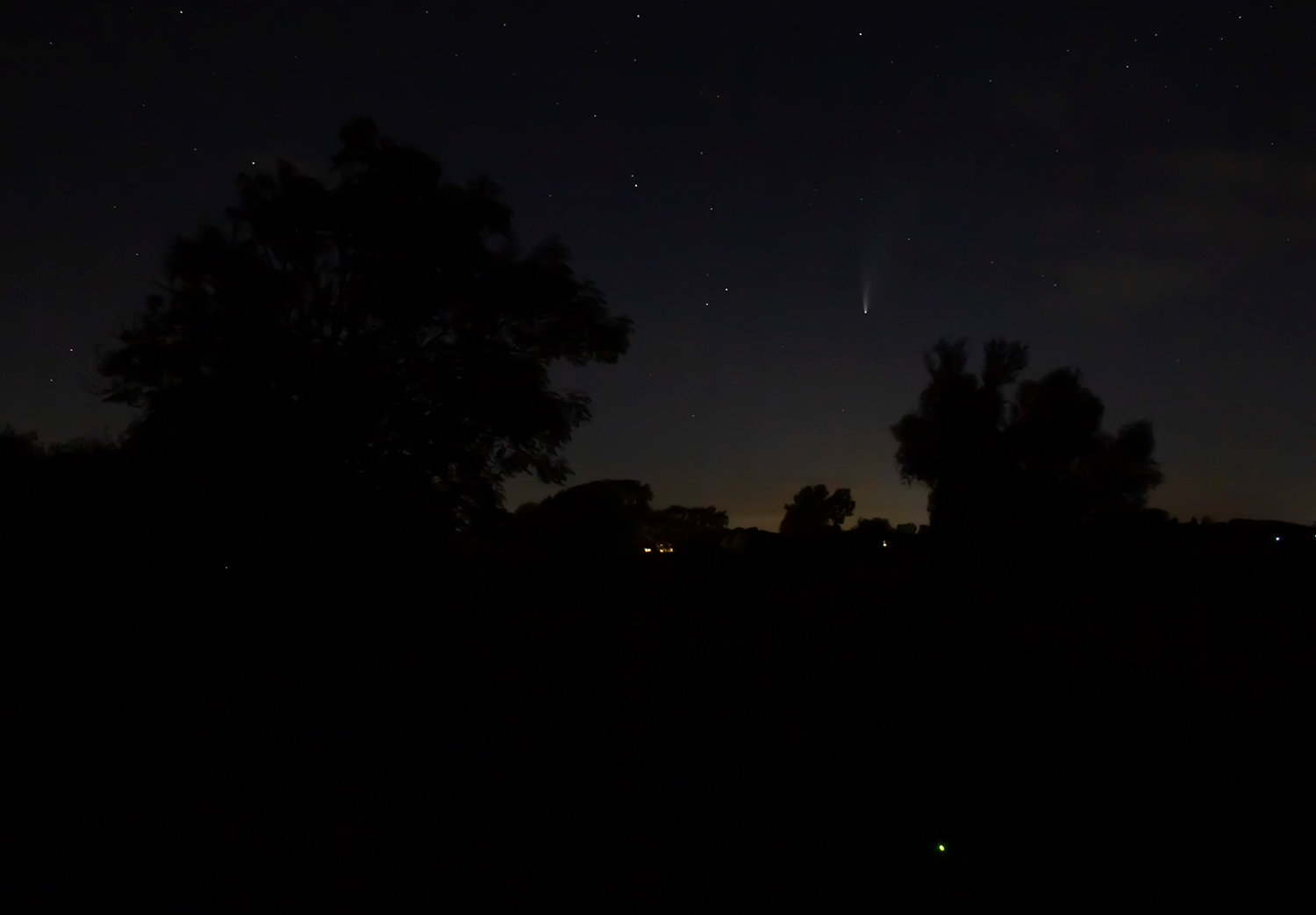
Finally, I went for ‘The Big One’: combining comet, landscape AND Glow-worm. Here is my best effort at this photograph…

Comet NEOWISE plus Glow-worm, north Cambridgeshire, 16.7.20
Then for luck, one with Eddie and his friend Lydia (with the comet flaring from Ed's hair!) plus the Glow-worm...